|
|
||
|
|||
Is it hot enough for you? |
| By EMT-B / IV Tech Scot Best | |
| July 5, 2010 | |
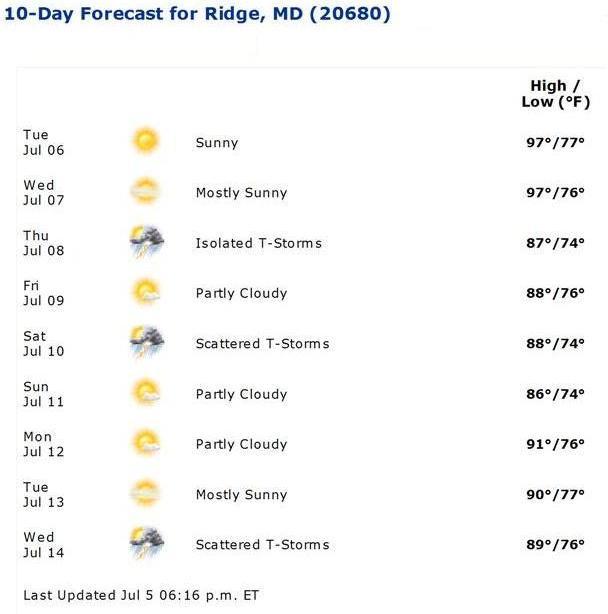
| Today, the National Weather Service issued a Special Weather Alert for Southern Maryland for heat index values between 98 and 102 degrees. Further, the Metropolitan Washington Council of Governments issued a Code Red Air Quality Alert for the DC metro area, which includes all of Southern Maryland. A Code Red Air Quality Alert means that air pollution concentrations within the region are unhealthful for the general population. The effects of air pollution can be minimized by avoiding strenuous activity or exercise outdoors. With the temperatures in the area expected to remain in the high 80's to high 90's this week, plus the combination of heat and humidity, heat index values could rise up to the low 100s during the afternoon hours all week. These extreme temperatures will most likely prompt daily Heat Advisories from the National Weather Service. A Heat Advisory is issued when the Heat Index (the temperature the body feels when heat and humidity are combined) is expected to exceed 105 degrees F, or if nighttime lows are expected to be greater than 80 degrees F for two or more nights. Exposure to full sunshine can increase the heat index by 15 degrees F. Heat Advisories should be taken seriously as the combination of hot temperatures and high humidity will combine to create a situation in which heat illnesses are possible. According to the National Weather Service, about 237 Americans succumb to the taxing demands of heat every year. Our bodies dissipate heat by varying the rate and depth of blood circulation, by losing water through the skin and sweat glands, and as a last resort, by panting, when blood is heated above 98.6 degrees F. Sweating cools the body through evaporation. However, high relative humidity slows down evaporation, robbing the body of its ability to cool itself. *The American Red Cross urges the community to take note of the following Heat Emergency terms:
- Heat exhaustion: Typically occurs when people exercise heavily or work in a hot, humid environment where body fluids are lost through heavy sweating. Blood flow to the skin increases, causing blood flow to decrease to the vital organs. This results in a form of mild shock. If not treated, heat stroke may occur. - Heat stroke: (a.k.a., Sunstroke) is life-threatening! The body's temperature control system, which produces sweating to cool the body, stops working. The body temperature can rise so high that brain damage and death may result if the body is not cooled quickly. *If a Heat Advisory is predicted or issued:
- Stay indoors as much as possible. If air conditioning is not available, stay on the lowest floor, out of the sunshine. Try to go to a public building with air conditioning each day for several hours. Remember, electric fans do not cool the air, but they do help sweat evaporate, which cools your body. - Wear lightweight, light-colored clothing. Light colors will reflect away some of the sun's energy. - Drink plenty of water regularly and often. Your body needs water to keep cool. Drink even if you do not feel thirsty. Water is the safest liquid to drink during heat emergencies. Avoid drinks with alcohol or caffeine in them. They can make you feel good briefly, but make the heat's effects on your body worse. This is especially true about beer, which dehydrates the body. - Eat small meals and eat more often. Avoid foods that are high in protein, which increase metabolic heat. - Avoid using salt tablets unless directed to do so by a physician. *Signals of Heat Emergencies:
- Heat stroke: Hot, red skin; changes in consciousness; rapid, weak pulse; and rapid, shallow breathing. Body temperature can be very high -- as high as 105 degrees F. If the person was sweating from heavy work or exercise, skin may be wet; otherwise, it will feel dry. *Treatment of Heat Emergencies:
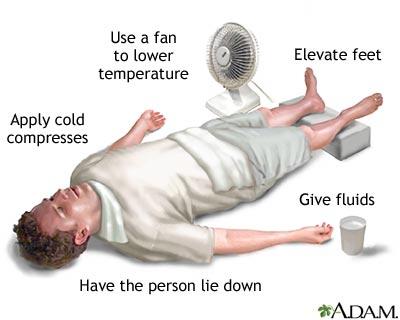
- Heat exhaustion: Get the person out of the heat and into a cooler place. Remove or loosen tight clothing and apply cool, wet cloths, such as towels or sheets. If the person is conscious, give cool water to drink. Make sure the person drinks slowly. Give a half glass of cool water every 15 minutes. Do not give liquids that contain alcohol or caffeine. Let the victim rest in a comfortable position, and watch carefully for changes in their condition. - Heat stroke: Heat stroke is a life-threatening situation. Help is needed fast. Call 9-1-1 or your local emergency number. Move the person to a cooler place. Quickly cool the body. Immerse victim in a cool bath, or wrap wet sheets around the body and fan it. Watch for signals of breathing problems. Keep the person lying down and continue to cool the body any way you can. If the victim refuses water or is vomiting or there are changes in the level of consciousness, do not give anything to eat or drink. |
|
|
|
||
|
|||